
HOW DOES AXS MESH WORK?
AXS Mesh works by controlling how heat moves through and around flammable liquids. Its effect depends on whether the fuel is contained inside a closed tank or exposed at an open surface.
In closed containers, AXS Solutions stop the propagation of heat.
In open containers, AXS Solutions break the Circle of Fire.
CLOSED TANKS
Closed tanks represent the broadest range of AXS applications. In a confined fuel space, the critical issue is how rapidly heat and pressure develop after ignition.
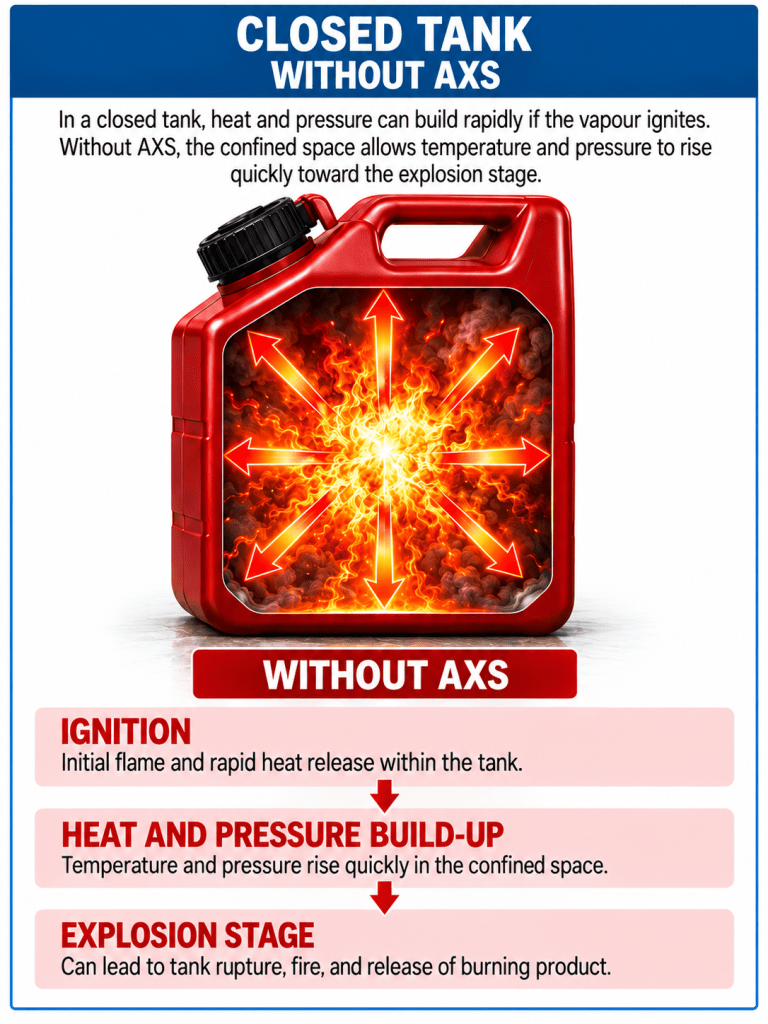
Closed Tank without AXS
Inside a closed fuel tank, ignition occurs within a confined space. Heat remains concentrated around the ignition region, temperature rises, and the surrounding vapor is heated. Because the tank is closed, the developing energy cannot disperse freely to the surrounding atmosphere.
The result is a rapid rise in heat, temperature and pressure. As the event develops, the tank can progress toward the explosion stage.
Closed Tank with AXS
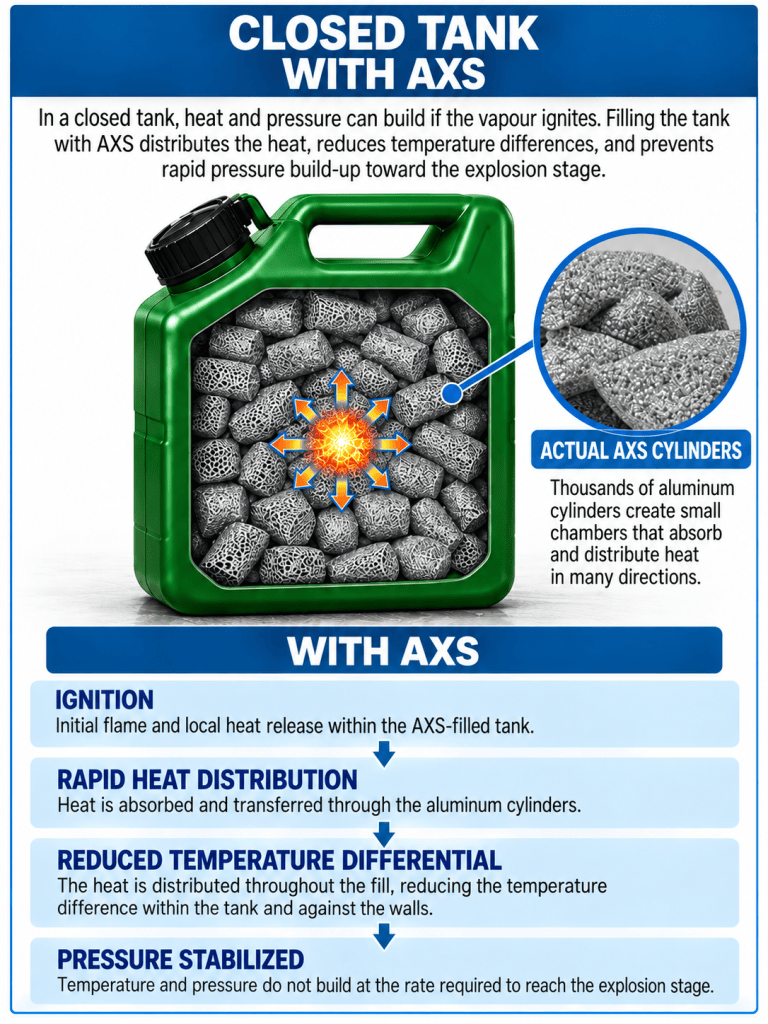
When the tank cavity is filled with AXS, the thermal behavior changes. The expanded-aluminum mesh provides a large heat-transfer surface throughout the filled cavity.
Heat developing around an ignition point is absorbed and distributed through the AXS-filled volume instead of remaining concentrated in one region. This reduces temperature differences within the tank and against the tank walls.
The sequence becomes localized heat → rapid heat distribution → reduced temperature differential → reduced rate of pressure rise.
AXS Cylinders also divide the cavity into many small, irregular spaces, helping keep localized combustion and pressure effects distributed rather than allowing them to develop freely across the full tank volume. The combined effect helps prevent heat and pressure from building at the rate required for the event to progress toward a larger explosion.
OPEN CONTAINERS
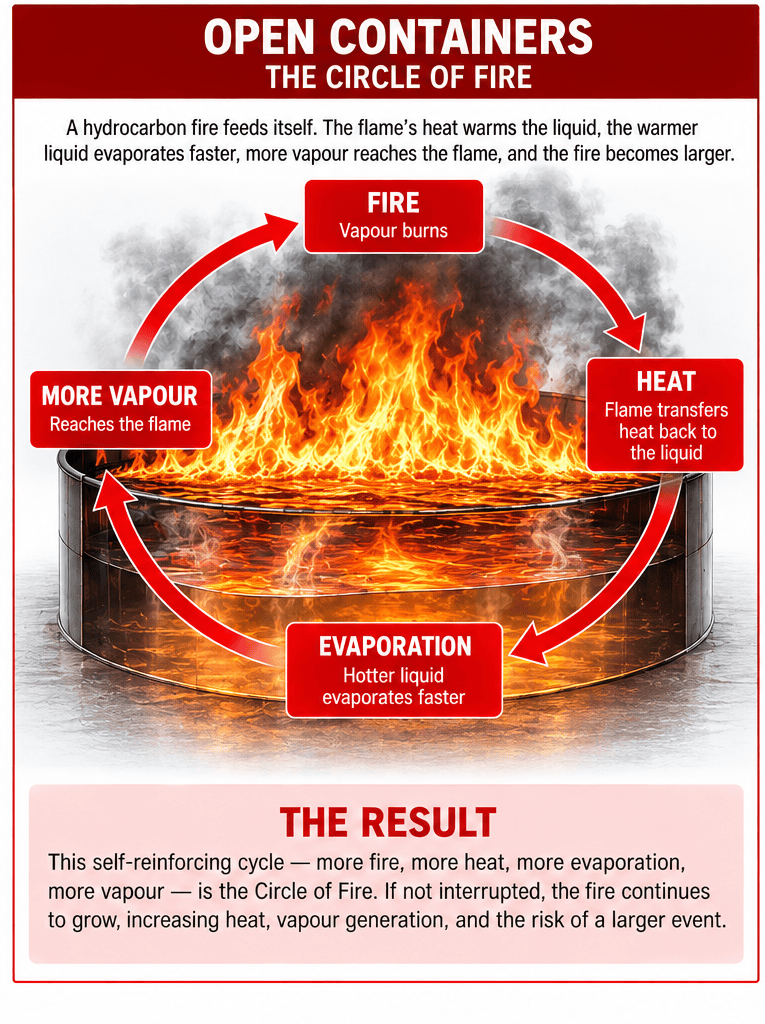
On an exposed fuel surface, the problem is different. Heat from the flame feeds evaporation, and the additional vapor feeds the fire.
The Circle of Fire
An open fuel fire can sustain and intensify itself through a continuous thermal cycle. The flame produces heat. That heat returns to the fuel surface. The warmer fuel evaporates more rapidly. More fuel vapor rises from the liquid and feeds the flame. The larger flame produces still more heat.
FIRE → HEAT → EVAPORATION → MORE VAPOR → MORE FIRE
This self-reinforcing cycle is the Circle of Fire.
AXS Breaks the Circle of Fire
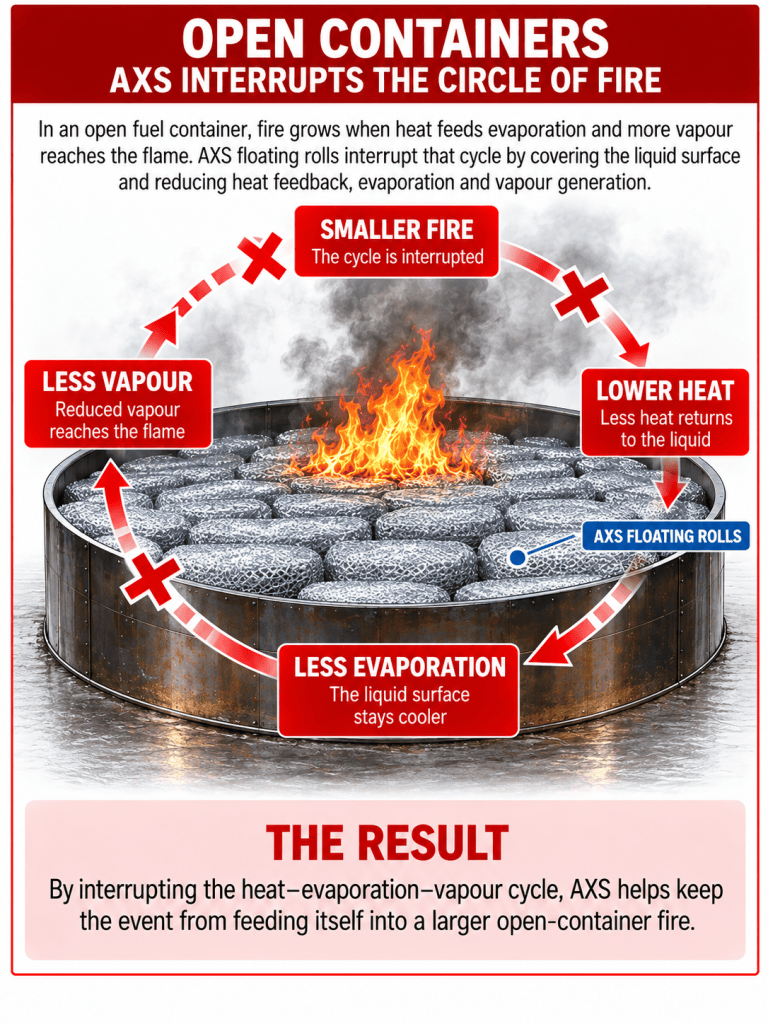
When AXS Floating Rolls are placed on the fuel surface, they enter the thermal cycle between the fire and the liquid. The expanded-aluminum mesh absorbs and distributes heat across its large surface area.
Less concentrated heat reaches the liquid fuel. With less heat reaching the liquid, evaporation is reduced. With less evaporation, less fuel vapor is available to feed the flame.
The fire may remain above the AXS Floating Rolls, but the self-feeding thermal cycle is weakened. AXS helps break the Circle of Fire by interrupting the heat-driven feedback that allows an open fuel fire to continue escalating.
ONE MESH, TWO SOLUTIONS SOLVING DIFFERENT PROBLEMS
In Closed Containers
AXS Solutions stop the propagation of heat.
In Open Containers
AXS Solutions break the Circle of Fire.
AXS does not change the fuel. AXS changes the conditions that allow the event to grow.

